Background Discussion
Germany’s Reform of Foreign & Military Intelligence
February 2026
Thursday
26
14:00 - 15:00
(CET)
with
Programmes
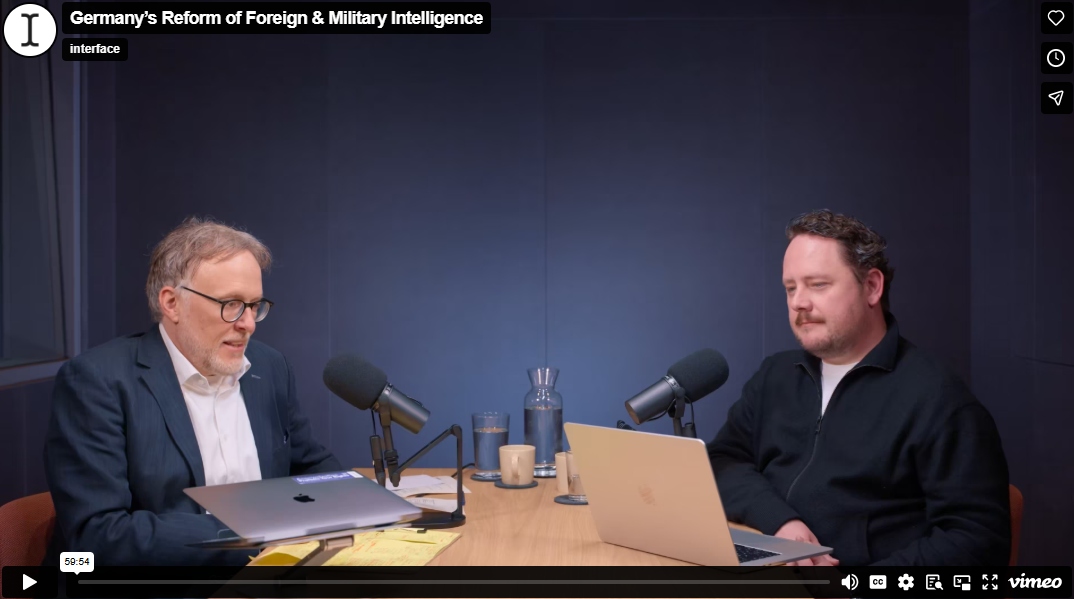
Following Russia’s war against Ukraine, Germany unlocked billions of Euros to strengthen its defence sector. Next up is national security: A new draft bill seeks to turn Germany’s foreign intelligence service, the Bundesnachrichtendienst (BND), into an operational powerhouse with new offensive cyber and investigatory powers. Key military equipment and expertise might also come under the BND's command.
The yet unpublished draft legislation significantly reduces the barriers for government access to data, cuts back independent oversight and allows the domestic use of some of these powers.
This merits further scrutiny. I have invited Florian Flade, a renowned investigative journalist, to shed light on the government’s plan for foreign intelligence reform. He specialises in national security working for Germany’s public-service broadcasting network ARD. He is also the only known journalist to date with direct access to the comprehensive draft legislation. We will discuss whether the envisaged reform strengthens Germany’s national security or weakens the foundation of its democracy.
Event Readout
interface hosted a webinar to shed critical light on new investigatory and operational powers that the German Chancellery plans to write into future foreign intelligence legislation.
Participants
• Dr. Thorsten Wetzling, Lead Digital Rights, Surveillance and Democracy (interface)
• Florian Flade, Investigative Journalist ( ARD )
The discussion highlighted specific aspects of the comprehensive draft BND Act that currently spans over 300 pages. The Chancellery sees a need to further strengthen the German foreign intelligence service in response to rising national security threats an d a shifting geopolitical landscape. Yet there are additional drivers to the reform, and the question arose whether the BND is actually as constrained as the Government likes to have it portrayed in public discussions. Also, the question arose whether Ger many has actually become a less credible partner in international intelligence cooperations in recent years.
Key themes raised during the webinar were:
From Information Gathering to Executive Action
A central theme was the BND’s proposed transition from a traditional information gathering agency to one with substantial executive powers. According to the draft bill, the BND, the foreign intelligence agency, would be empowered – even domestically – to conduct
• sabotage, e.g. to carry out activities to weaken hostile military capabilities.
• cyber operations, e.g. to dismantle enemy weapon systems, to divert data flows or to attack IT infrastructures
• active Cyber Defense, e.g. the agency would have the authority to hack foreign service providers and install spyware on electronic devices by entering homes.
Some, but not all of these powers, seem to be reserved for, or can only be used in conjunction with, a newly defined "special intelligence situation", which needs to be declared by the newly found German Security Council and is subject to a two - third majority vote of the Parliamentary Intelligence Oversight Committee.
The future design and regulation of military intelligence in Germany
The draft law explicitly defines the BND as Germany’s "civilian and military intelligence service". This marks a major structural shift, as military intelligence has traditionally been the remit of the German Armed Forces (Bundeswehr). Flade noted that this change has prompted concerns within the Ministry of Defence regarding the potential consolidation of resources and personnel under BND command. Wetzling noted the need for a statutory framework for intelligence collection by the German Armed Forces and c alled for more rigorous oversight thereof.
Expanded Signals Intelligence and Data Access
The reform also proposes a significant expansion of the BND’s technical capabilities, supported by a budget increase of €350 million to €1.51 billion. Key changes include:
• The BND would be allowed to store up to 30% of intercepted internet traffic (including the full content of emails and chats, not only metadata) and the data retention period would extend to 15 years;
• The draft allows the BND to access telemetry data from car manufacturers and service providers. This raises the question whether this type of data will be accessed through commercial vendors such as data brokers. Wetzling noted that the current German lega l framework and oversight practice is insufficient to mandate and review the German intelligence community’s use of data purchased from data brokers.
• The draft generally places a restraint on the BND when it comes to recruiting minors under the age of 16 but the BND President can authorise the recruitment of 16 and 17-year-olds, as well as members of parliament and their staff.
Reshaping Intelligence Oversight
Apart from these expanded surveillance and operational powers, the discussion also shed light on how the government is likely to redesign the current landscape for independent intelligence oversight at the federal level:
• The Independent Control Council (ICC) might receive expanded competences for both ex -ante (before the fact) authorisation and ex-post (after the fact) reviews of BND activities, not just regarding signals intelligence.
• The ICC might also be mandated to authorise and review some of the surveillance activities of the federal domestic intelligence agency, the Bundesamt für Verfassungsschutz (BfV). Wetzling suggested that the review of the German Armed Forces' intelligence c ollection through the Militärisches Nachrichtenwesen (MilNW) should also fall under the purview of the ICC.
• At least at the federal level, the pending reform may also abandon the G10 Commission and shift its authorization and oversight duties to the ICC.
• The Federal Commissioner for Data Protection (BfDI) might also lose its entire mandate with regard to the federal intelligence agencies.
"The BND will be a new intelligence service, an intelligence service that is no longer restricted to gathering information... it will be a service and authority that is allowed to act operationally."
— Florian Flade, Investigative Journalist (ARD)
“The BND is anything but an insignificant intelligence actor. We know for instance that back in 2020 the BND was already collecting 1.2 trillion internet transactions per day at the DE -CIX internet connection hub. It may also access troves of commercially - sourced data without a sufficient legal mandate at the moment.”
— Dr. Thorsten Wetzling, Lead Digital Rights, Surveillance and Democracy (interface)
The government likely aims to have a Cabinet decision on the BND reform well before the summer break. For more information on interface’s work regarding intelligence oversight and legal frameworks for surveillance, please visit www.nachrichtendienstreform-2026.de or contact Dr. Thorsten Wetzling at twetzling@interface-eu.org.
Meet the speakers

Dr. Thorsten Wetzling
Lead Digital Rights, Surveillance and Democracy